 par
par ARCHIVES : Articles by Marie-Agnès Bruneau Published in the International Press
Published in REALSCREEN, June 27, 2024
The annual Sunny Side of the Doc conference has just wrapped up in La Rochelle, France. Marie-Agnès Bruneau is on the scene, reporting for Realscreen.
Against the backdrop of a tumultuous political landscape in France, Sunny Side of the Doc’s 35th edition was a busy one, with an uptick in attendance from last year’s event (2,100 attendees, including 250 international decision makers, compared to approximately 2,000 last year) and an international contingent hailing from 68 countries, compared to 64.
That increased international presence added extra buoyancy to the fest’s typically robust international coproduction activity, with official pitching sessions proving as popular as ever — the session for Impact Campaign pitches especially so.
Perhaps never as much as now, international coproductions, which have always been at the heart of Sunny Side, are proving to be prerequisites for documentaries, as broadcasters face stiff competition from streamers while contending with budget cuts. This year, some high-end players in the doc space expressed new needs.
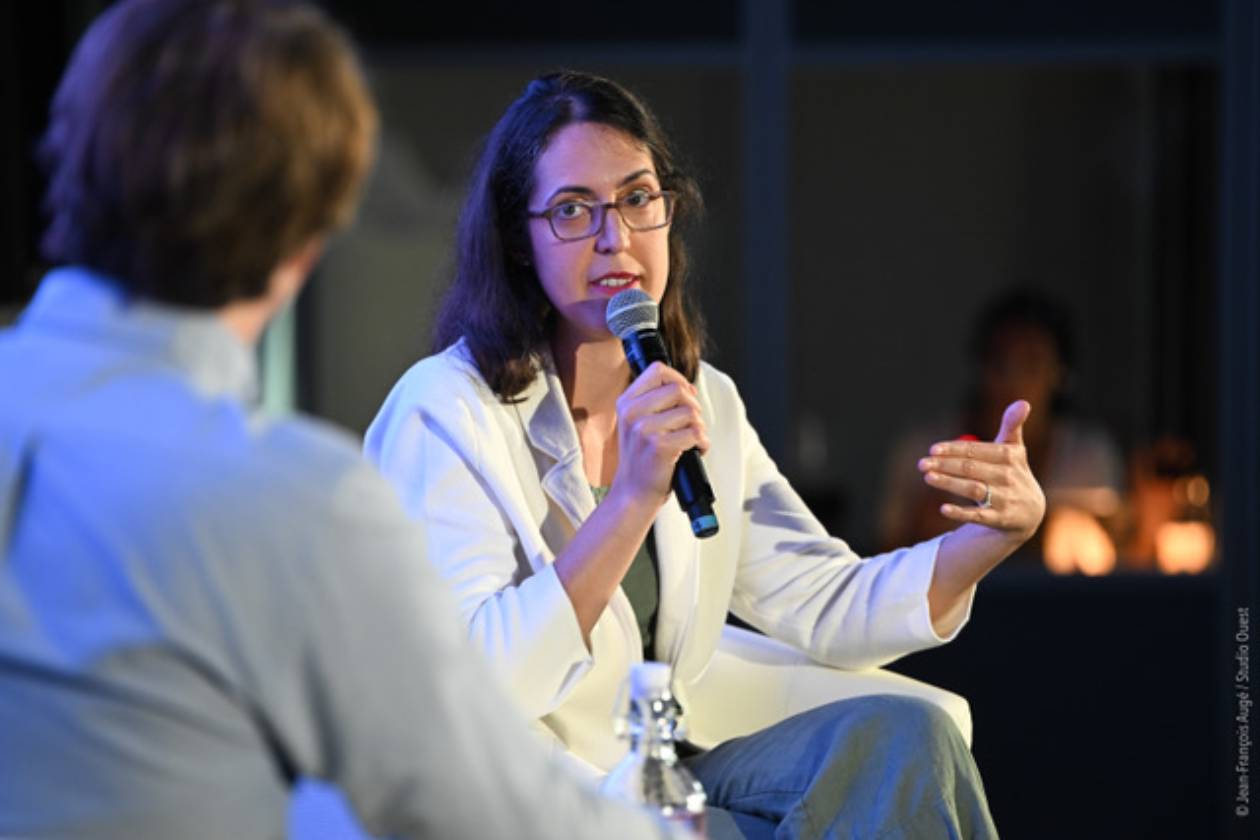
Making the trip to Sunny Side for the first time, Diana El-Osta (pictured), senior director of programming and development for PBS, stressed how important international coproductions now are for the U.S. public broadcaster. “PBS has always looked to collaboration,” she told delegates during a keynote conversation, while admitting that while, in the recent past, two to three broadcasters could be enough to fund a project satisfactorily, “now you need four or five.”
Life in linear
Still, despite the challenging financial landscape, there was ample evidence of activity for broadcasters active in linear and streaming.
National Geographic was on hand to introduce its London team, which is actively looking for European coproductions meant for linear National Geographic Channels International (NGCI) outlets. The Nat Geo team members on hand to address delegates — including global acquisitions director Ben Noot, development and production exec Alexander Lawson, and commissioning exec producer Sarah Peat — emphasized that the network is in “very collaborative” mode, working with other broadcasters such as SBS Australia or Channel 4 on copros and ready to help producers establish partnerships for shows that NGCI is interested in.
When it comes to content, “repeatable and scalable” are the key words for Nat Geo, with an eye towards building franchises such as the From Above and Lost Treasure of… series.
Beside its call for projects for the next edition of the Global Doc initiative, France Télévisions also unveiled a renewed partnership with BBC Studios, and revealed the two winners of another call for projects, this time for a copro partnership between Italy’s RAI and FTV.
Also on the international front, Australia was one of the regional focuses this year, with a session on First Nations and Indigenous filmmakers looking for international partners to tell their stories.
One company conspicuous by its absence was Netflix — as opposed to the Cannes Lions, where the platform once again rented the entire rooftop of the JW Marriott. Last year at Sunny Side, Netflix France held a panel session. But since then, the team has changed, with former director of non-fiction Mark Edwards having left earlier this year.
Creativity required
While broadcasters maintained that there was still life in linear, they were also adamant that remaining relevant with younger audiences means rejuvenating documentary storytelling.
Vincent Regnier, head of C Production, the producing subsidiary of France’s M6 network, said that while the net is the French channel with the youngest audience (at an average age of 54), “the figure continues climbing,” resulting in a need to consistently evaluate the reach of its content.
For that reason, broadcasters are looking for new forms of storytelling. Both NHK and Arte pointing towards projects that utilize new techniques — from animation to VR — for wider demographic appeal. As in the U.S., some podcasts are also being adapted into documentaries.
Some international broadcasters on hand acknowledged they were also looking to AI to add new flair to projects. Singapore-headquartered broadcaster Mediacorp, for example, has a couple of blue-chip history docs in production that will feature more than 30% AI-generated content, using such tools as text-to-image and image-to-image prompts to recreate aerial shots from old maps and pictures or animate photographic imagery. Similarly, Canal+ announced a docudrama miniseries on Napoleon for its cabsat channel Planete+ that will use AI to animate figures in paintings.
Uncertainty ahead
But while the general mood at the event was upbeat, there was no way to ignore the dark clouds threatening Sunny Side’s host country, following the political unease earlier in the month that led to parliamentary dissolution and a hastily called national election that will happen this weekend and next. Depending on the end result, public broadcasters and their documentary output could be impacted, as the privatization of France Télévisions and Radio France is a campaign promise for some parties on the far right.
The uncertainty was addressed in a Q&A following France Télévisions’ lineup presentation, with one producer asking: “This moment is so serious, what can we do?” In response, France Télévisions president Delphne Ernotte said she refuses to think the worst when it hasn’t yet arrived. She added that the privatization process can’t happen just like that, and at the very least must first be passed into law. Nevertheless, the current situation is freezing many things, and there are still questions about funding after this year.
According to producers union USPA, France Télévisions represents 46% of French documentary funding, and these questions also might impact the agreement that producers unions just reached with the pubcaster, which sees France TV committing to a bit higher €440m for drama, animation and documentaries, including €105 million for documentaries. But as the agreement is just a memo deal at the moment, it is not yet set in stone.
Political concerns were also put forward during the Canal+ presentation. While there was no official Q&A, a producer still posed a question to longtime documentary head Christine Cauquelin regarding Canal+ shareholder Group Bolloré and some of its channels’ support of the far right. “This is a very nice showcase,” the producer offered, “but who is it that we are working for?”
“I’m only in charge of the showcase,” answered Cauquelin.
