
 par
par ARCHIVES : Articles by Marie-Agnès Bruneau Published in the International Press
Published in REALSCREEN, July 4, 2024
One of the key elements of documentary is adherence to reality — even when filtered through the perspective of the filmmaker. With the advent of artificial intelligence, creatives and commissioners around the world are examining how the burgeoning technology can, and will, impact the genre.
AI was a central topic at several of the sessions at this year’s Sunny Side of the Doc in La Rochelle, with several panels tackling some of the major issues that the technology is raising for doc-makers.
During the “Archives, AI and Ethics” panel, speakers stressed the importance for transparency as well as ethical use of the technology — specifically, generative AI.
Joining via video from New York, Stephanie Jenkins, archival producer and co-founder of the Archival Producers Alliance, presented an example of a recreation created with OpenAI’s Sora via a text prompt of so-called “historical footage” — an aerial shot of Gold Rush–era California from 1848. Of course, as she pointed out, “drones did not exist in 1848,” and naturally, the resulting “footage” had a wealth of inaccuracies. “We spend a lot of time making sure we are accurate, and this is a good example of what we can worry about,” she said, regarding filmmakers who may be tempted to incorporate such material into their work.
The APA has been working on a set of guidelines for the use of GenAI coming out in September. [Look for more regarding this in the next edition of Fred Grinstein’s “Brave New World” column, coming next week – Ed.] While workflow automation isn’t necessarily a huge component of its focus, Jenkins also flagged colorization using AI as containing “some contentious issues.”
The importance of tagging AI content was addressed by tech consultant Paul Melcher. “There won’t be a technology able to detect it, so we need labels on content if it’s generated,” he said, stressing the need for a tool to identify “the partners and where it comes from” so that viewers can decide whether it’s trustworthy.
Virginia Bazàn-Gil, general secretary of the International Federation of Television Archives (FIAT/IFTA), said that AI can be utilized for its capacity to improve process and access to content, as well as for aiding with making programming more inclusive through automatic subtitles, translation, or colorization. For example, she highlighted NHK Enterprises’ “virtual human interpreter,” Kiki, which is able to translate sign language of signs.
But here too she stressed the importance of ethics, especially when sharing data for AI training. “Transparency is key,” she emphasized.
During the session, a producer asked for advice on whether he should sell his wildlife library footage to companies that would use it to train AI. “I would say go ahead if you’re paid for it,” offered Melcher. “Licensing is a way to control it, because it will probably happen even if you don’t license it.”
“You should think twice,” countered Bazàn-Gil. “It’s going to be used by private companies, [so] you need to get ethical and legal expertise beforehand.”
Still, another panel on the practical uses and creative possibilities for broadcasters and filmmakers exploring GenAI showcased how unpredictable and prone to mistakes the tech still is. Czech director Petr Sakaba, who has been working on an AI-generated film on the development of life from microscopic organisms to computing systems, said he has been partly using black and white as a graphical style to imply the past, but also because it hides imperfection. Nevertheless, he emphasized how fast the technology evolves.
France’s ArteFacto Films is working with Runway Studios on the OpenDocs initiative, providing AI support to a selection of projects, with a first round of five having been produced. Asked what was the common feeling among directors in working with AI, Anna Giralt Gris, ArteFacto CEO, answered, “Frustration! They found out that [working with] text [prompts] is super-limited!”
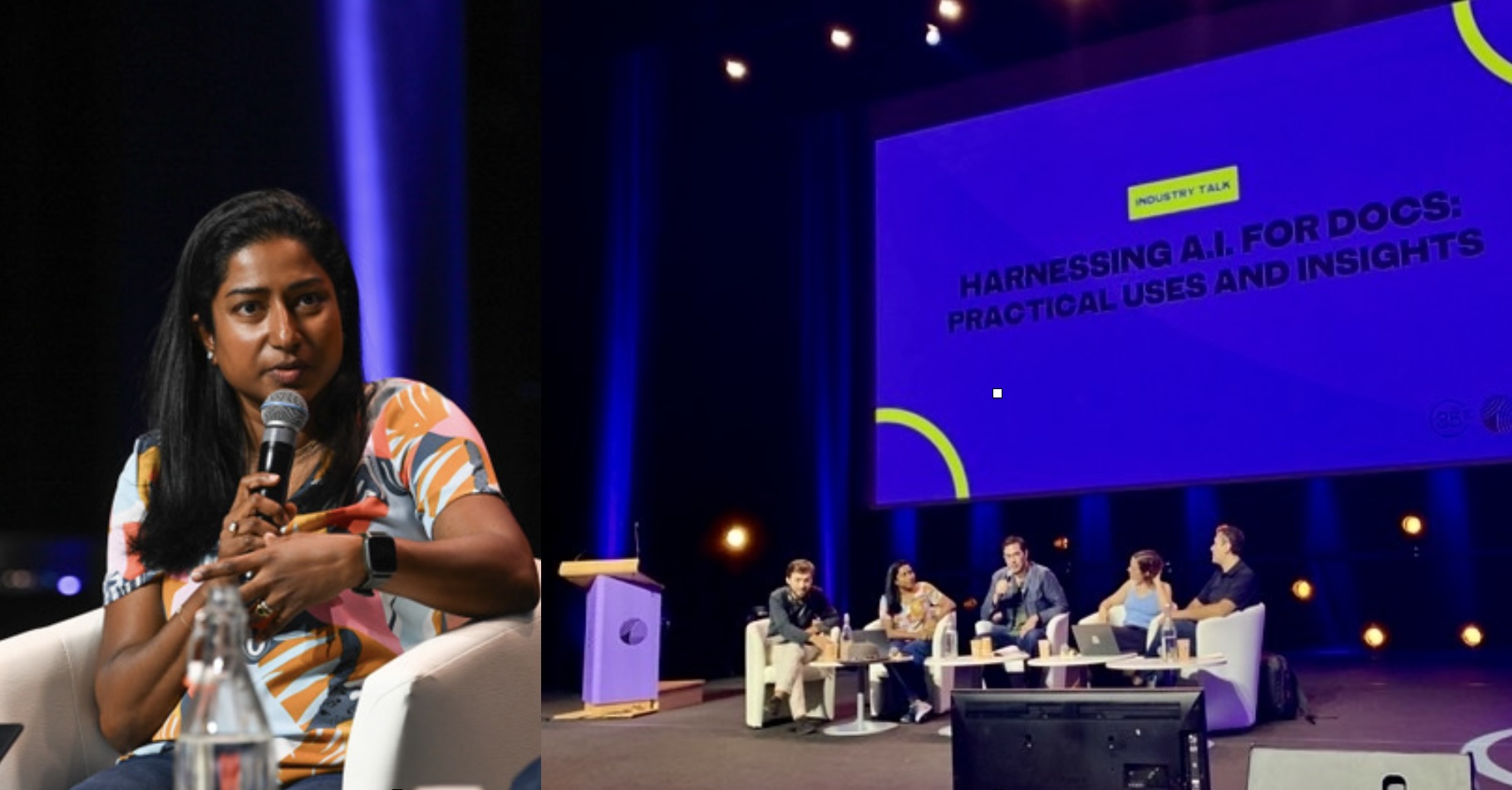
“You need some VFX, it cannot exist on its own,” said Shamala Rajendran, Mediacorp executive editor for content commissioning (pictured). The Singapore-headquartered company has a couple of blue-chip history docs in the works that are utilizing between 30-40% AI. The tech is being used for aerial shots, with historical photographs and maps matched with present-day aerial and ground footage, as well as for some character animation, such as facial expressions. Footage will also receive an AI-aided colorization process. Still, producers are using After Effect to rework the AI, as sometimes the look can be “a bit fantastical,” as she described.
While the processes are evolving, one thing is clear at the outset — the tech’s cost-effectiveness. “Compared to CGI, it must be a hundred or a thousand times cheaper,” said Sakaba, while noting that the two methods aren’t necessarily interchangeable. He added that someone using the tech while still learning the ropes can also waste a lot of time, “and time is money.”
“[The] human does not disappear,” offered Emmanuel Priou, Bonne Pioche co-founder. The acclaimed French prodco is currently halfway through production on a four-part docudrama for Planète+ on Napoleon III, which will use a great deal of AI — perhaps as much as 60% of the work that would typically be done with CGI — for uses such as bringing characters in engravings and paintings to life. However, Priou stressed that the project was only possible thanks to the human talent — a graphic designer who is proficient with the tech. “It wouldn’t have been possible with CGI because it would have been too expensive, and we have a limited budget [approximately €900,000].”
Still, Priou said that the story itself can, and perhaps should, dictate the technique. He pointed to another project underway on 19th-century balloonist Sophie Blanchard, which will use “the very traditional technique of puppets.”
