
 par
par ARCHIVES : Articles by Marie-Agnès Bruneau Published in the International Press
Published in REALSCREEN, June 30, 2025
The 36th edition of Sunny side of the Doc, which took place in La Rochelle from June 23 to 26, reported steady delegate numbers of around 2,100 (at par with last year’s attendance), though with changes in their composition. “Some countries were missing, but we gained new territories,” says Aurélie Reman, MD of Sunny Side of the Doc, who is on a mission to reposition the event in sync with market changes.
The event is aiming to diversify attendance across all documentary market segments, and become more inclusive by highlighting new voices. Reman notes increased attendance from India, Brazil and Africa, as well as Saudi Arabia for the very first time.
Another work in progress is to attract more international distribution players and buyers. Traditionally, Sunny Side of the Doc has been especially strong as an event for coproductions, primarily attracting producers and commissioning editors. As a result, more buyers were invited, and the total number of buyers and commissioning editors increased from 230 to 260. “Next year we’ll be inviting even more,” Reman tells Realscreen.
The effort also addresses those who miss having a spring MIPDoc sales event (MIPDoc moved to the first edition of MIP London last year). However, Reman states that this is not the sole reason.
“We know that the documentary market is becoming increasingly complex, with less money around. Our goal is to provide clarity and solutions, and to multiply potential co-funding partners. Distributors now play a much greater role in funding,” she says. Some, however, suggest the timing isn’t as good for direct sales as what a spring MIPDoc provided. “It’s harder to do the follow-up in the summer,” she acknowledges, “but I don’t think we’ll be moving the date in the near future.”
“We’ve laid the foundations, and we now intend to continue building in the same direction,” Reman continues. “Next year, we’ll be looking to include new forms of funding and alternative funding players.”
Contradictory signs
Pitching sessions for this year’s edition of Sunny Side of the Doc were busy, as was the activity on the floor, and the usual international coproduction players were in attendance. However, the event was marked by contradictory signs. Amidst all the activity, the financial tensions gripping the industry could be felt, and the announcement during the market that long-established player Off the Fence was entering bankruptcy proceedings shocked many.
The decision-making process is slower, with those broadcasters who aren’t reducing buying outright temporarily pausing commissions as they grapple with budget cuts. In France, for example, Canal+ froze commissions for several months. The pay-TV group announced during Sunny Side that it would resume commissioning documentaries in September, and also promised that annual investment would remain stable, but focused on a smaller number of titles in order to fund fewer projects but with bigger budgets.
French producers and writers-directors’ unions also expressed concerns about the government’s public broadcaster reform project, which aims to create a single holding company to manage both France Télévisions and Radio France and might prompt further budget cuts.
Meanwhile, there are still some signs of growth for the industry in the area of new platforms. For example, a newer French broadcaster, Novo 19, announced at Sunny Side that it is launching a DTT platform in September, and will be open to coproductions.
Pubcasters at risk
Threats to public broadcasters, who are the biggest documentary commissioners, are multiplying worldwide, as exemplified by the Trump administration’s recent actions against PBS. The U.S. pubcaster, a major player in international coproductions, was nevertheless in attendance at the event.
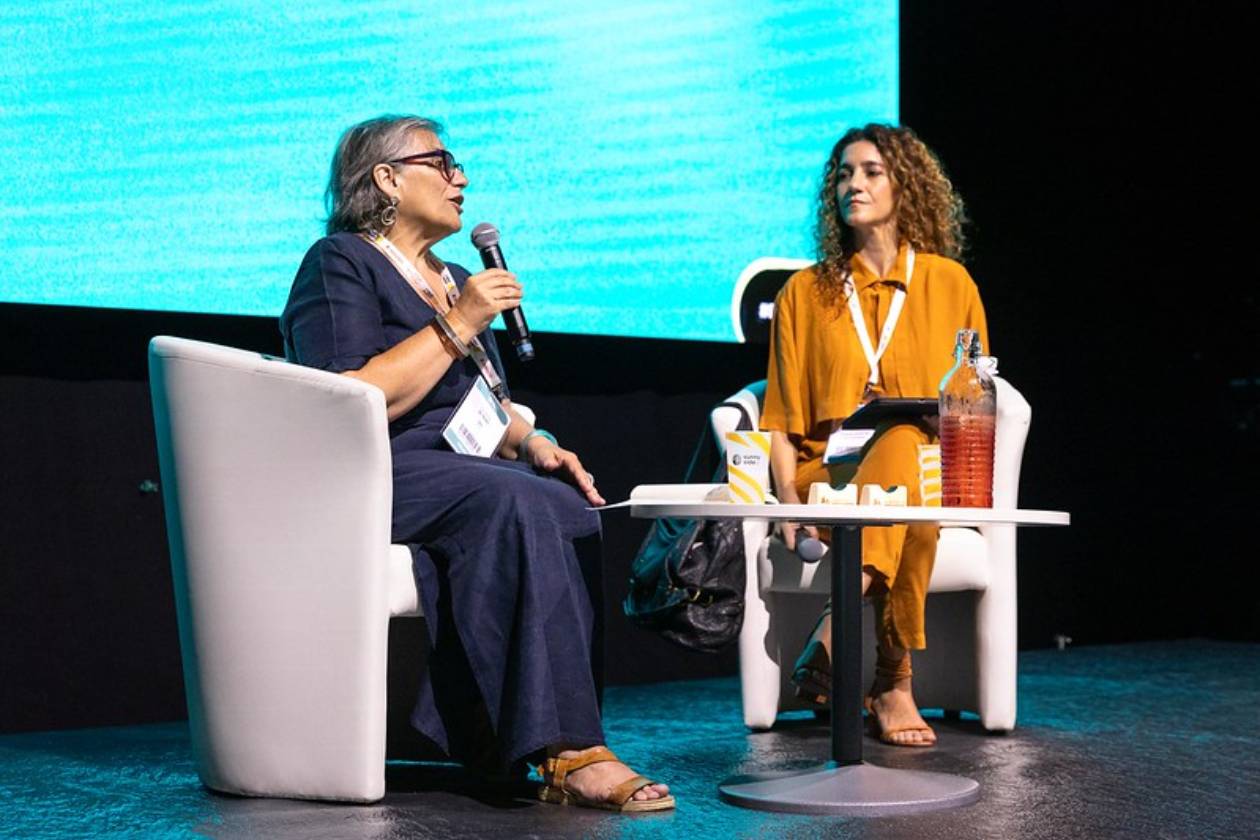
The impact of political change on public broadcasters was illustrated by the keynote speech of EBC/TV Brasil’s director of content, Antonia Pellegrino (pictured left). She recounted how the channel had to entirely reconstruct itself after the previous regime of Jair Bolsonaro implemented drastic budget cuts, feeding the channel with governmental content.
With a new government, TV Brasil had its public mission reinstated, with the goal of helping to strengthen democracy and win back lost audiences. This had to be achieved with a mere €3.5 million budget. She called the end result “a Brazilian miracle,” adding that this was made possible thanks to cost-effective programming acquisition choices, like buying women’s football and Turkish soaps, as well as partnerships for original documentaries with Brazil’s Ministry of Culture and film agency Ancine.
The latter granted TV Brasil €45 million to support Brazil’s independent production in commissioning documentaries for its flagship nature strand. The channel is now getting involved in its first coproductions, having joined Global Doc and issued a call for projects together with France Télévisions for a doc for its nature strand. “Brazil has a great diversity of nature and is a key player in the climate change debate,” Pellegrino said.
Commitment to climate change and science docs
In these troubled times, PSBs are taking their public service mission as seriously as ever, with a continued strong commitment to climate change and science programming. NHK, for example, premiered its latest major coproduction with Bhutan Broadcasting Service (BBS), Run Against Time: The Snowman Race in Bhutan, which addresses the issue of melting Himalayan glaciers.
“The role of public service is needed,” said Shin Yasuda, senior producer of NHK, which was commemorating its 100th anniversary at Sunny Side. He shared that the Japanese broadcaster’s origin story has great relevance today, as NHK was created in 1925 following a major catastrophe — an earthquake — which was followed by a great deal of misinformation. “This is happening again,” he said. “I don’t know on what scale, but public service [television] needs to survive.”
The Japanese broadcaster was also celebrating 35 years of international coproductions, with its first being The Silk Road with CCTV in 1980. The Sunny Side reception featured messages of congratulations, both live and via video, from the international production community.
For its 2024-25 slate, NHK has six ambitious international documentary copros on tap for its ‘Science and History Frontier’ strand, including the latest installment of its blue-chip Deep Ocean series. Additionally, it will be pre-buying or coproducing another six for its ‘World Documentary’ strand. For the latter, NHK annually acquires 80 documentaries, and 40 for its ‘Dramatic Planet’ strand.
New narratives
Broadcasters also continue to seek ways to attract young audiences on digital platforms and to search for narratives, an aspect central to most French broadcasters’ lineup presentations. France Télévisions, for instance, is introducing more docuseries and is trying its hand at comedy documentaries. Canal+ is also exploring this genre alongside thriller and action documentaries, such as a series on the French Foreign Legion, with each episode focusing on a single mission.
Arte believes it has completed its transformation from a channel into a full-fledged multimedia platform. Arte.tv, available in six languages, saw its number of streams improve by 18% in a year, reaching 2.8 billion in 2024. The number of subscribers to the numerous channels it developed across all social networks — YouTube and others — grew 12% in a year, hitting 32 million this month. The average age of viewers on YouTube is 35 years old, versus 60 for the linear channel.
“Digital development means more flexibility,” said Arte France chief content editor Boris Razon. “More flexibility in documentary forms, in their length, in their topics, and in the articulation between linear and online scheduling.”
The broadcaster is also commissioning more documentaries involving talents from troubled areas, as it did with the special doc strand ‘Generation Ukraine,’ or with the documentary feature film Imago, directed by Chechen filmmaker Déni Oumar Pitsaev, which won the Oeil d’Or award at the latest Cannes Film Festival. Arte is also going to coproduce a second series of ‘Generation Africa’ featuring projects from African directors on the topic of climate injustice.
“The world’s — and our European — values are threatened by misinformation, the climate crisis, the fragmentation of our societies, the brutalization of public speech, and the multiplication of wars,” commented Fabrice Puchault, head of Arte’s society-culture department.
“Everything we do must resonate with the world our viewers are experiencing, and I would even say, with political resonance,” he added. “That doesn’t mean making activist films, but rather focusing on the facts as well as their nuances.”
Photo: Hugo Lafitte
