
 par
par ARCHIVES : Articles by Marie-Agnès Bruneau Published in the International Press
Published in REALSCREEN, February 4, 2026
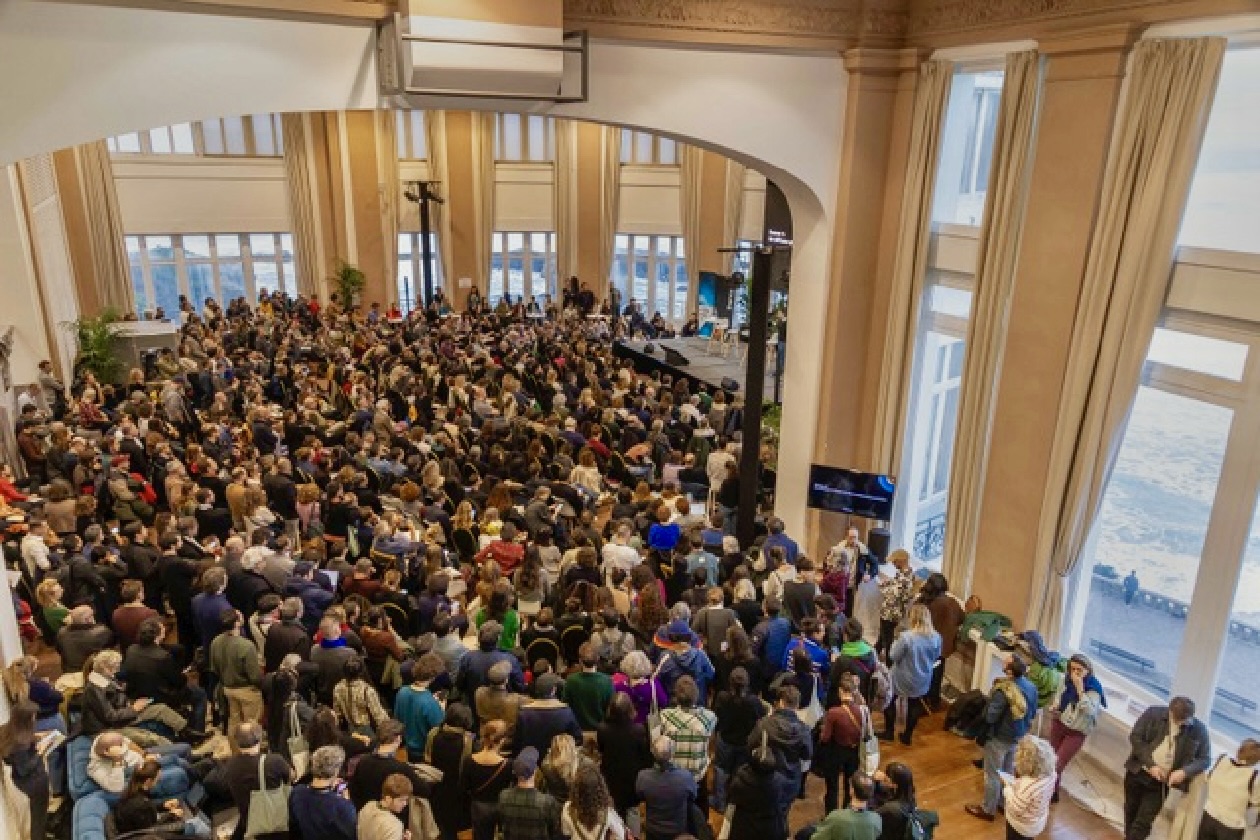
Last week’s Fipadoc documentary festival and conference in Biarritz revealed a shifting marketplace, signaling possible funding challenges ahead for the documentary genre.
Regarding the festival’s programming, Fipadoc president Anne Georget tells Realscreen that, given current global unrest, there was a desire to highlight films reflecting contemporary conflicts — some offering unique perspectives — while also providing the audience with some respite from heavier subjects. Screenings were followed by passionate discussions between film crews and local audience, which Georget notes spanned all age groups. As for the Fipadoc Pro industry days, she says that the coproduction forum was scaled up this year, benefiting from a strengthened European focus.
“We had around 350 international attendees, accounting for about 17-18% of total attendance, alongside some 1,900 French professionals,” says Bastien Gauclère, head of Fipadoc Pro. “This year, we focused specifically on our international pitches,” he adds. “We received 300 projects and selected 24.” Compared to other events, Fipadoc’s pitching sessions aim to promote author-driven and creative projects. “Many can easily transition between cinema and TV,” Gauclère notes.
To facilitate coproductions, each year the event highlights “countries of honor.” This year, those countries were Portugal and Spain, while next year it will be the Balkans. During the Spanish panel, director Elena Molina Merino — who recently won a Forqué Award for her feature doc Flores Para Antonio, backed by Movistar+ — emphasized that a new generation of women is directing documentaries in Spain, resulting in more women moving into production too.
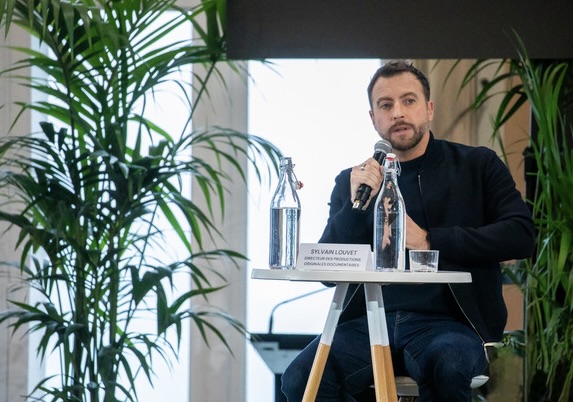
A newcomer with a significant presence this year, HBO Max France held its first-ever lineup presentation. The streamer, which launched in France in June 2024, is looking to develop a local documentary slate regardless of the impending merger with whichever suitor wins. While HBO Max has had involvement in the past in a couple of French docuseries, it is now accelerating, said Sylvain Louvet (left), who joined as head of original documentaries in May. Another eight series are in development, with a delivery target of four to six per year, he announced. The streamer is looking for untold serialized stories with strong narratives that fit the HBO style. This means they can incorporate humor or involve scripted writers, he said.
“At a time when there is so much bad news, we are here to bring the good news that at HBO Max, documentary is considered a major genre, one capable of attracting as much of an audience as drama,” he said.
This good news, however, was not enough to erase the prevailing concerns of French producers. The producers’ unions, alongside some writers’ and directors’ guilds, took the stage at Fipadoc together to issue a joint statement, highlighting the vital role of documentaries — and public broadcasters — within a democracy. They denounced the hostile campaign orchestrated by far-right politicians against France Télévisions, as well as the budget cuts recently implemented by the government.
Indeed, France Télévisions is currently facing a period of extreme turbulence. The pubcaster is under the spotlight of a Parliamentary Commission of Inquiry regarding public broadcasting neutrality, operations and funding. Furthermore, its budget is being cut for the second year in a row. At the end of last year, it decided to reduce its unscripted entertainment budget by 5%, cancel several shows, and increase reruns. Now, its commissioning budgets for drama, documentary, and animation are also under threat.
In addition, to drive further savings, the group announced it will introduce a new ‘streaming-first’ structure for its programming units in May. This reorganization will be based on mission-driven clusters — such as Knowledge, Creation, Regions, Cinema, Sports & Events, Lifestyle & Leisure and Young Audiences — rather than by genre. This shift is further fueling producers’ anxieties, as it means there will no longer be a dedicated documentary unit.
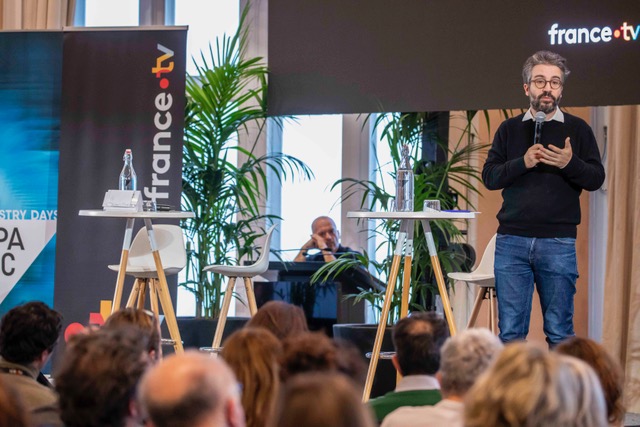
France Télévisions’ director of programming and broadcasting, Stéphane Sitbon-Gomez (left), opened the group’s lineup presentation (pictured top) by thanking the trade organizations for their statement, which he said “warmed his heart,” before attempting to reassure them. “Yes, there will be savings in programming, but the space for documentary will be preserved,” he stated. He also promised that trade organizations would be kept informed of the upcoming organizational changes and the allocation of budget cuts.
France’s other public broadcaster, Arte, which operates on a smaller budget than France Télévisions, has not been affected by budget cuts so far. However, some French private channels are also facing challenges, particularly thematic channels. In their statement, the trade organizations noted that the Canal+ Group had “halted all documentary commissioning for an extended period” last year. This time as a distributor, Canal+ Group reportedly has not yet renewed the carriage deal for TF1’s documentary channels, Ushuaia and Histoire TV. As a result, these channels did not present a lineup at Fipadoc this year.
Fortunately, producers’ unions recently secured a major victory: a key provision within streaming platforms’ local investment obligations. Streamers must now dedicate a minimum of 20% of their obligation to documentary and/or animation, preventing them from allocating nearly everything to drama. Biarritz also saw the first-ever lineup presentations from two small, last-year-launched DTT channels, Novo19 and T18, now beginning to step into documentary production. Novo19 has also come on board for a couple of unnamed international ancient history coproductions.
Among other concerns raised during the event — this time at the European level — is the evolution of Creative Europe, the EU’s media support program for 2028–2034. The program is set to be merged with CERV (Citizens, Equality, Rights and Values) to form a new entity called AgoraEU. Within this framework, the Media+ program will group audiovisual works together with video games and news with the total budget doubling. But the key questions for doc-makers remain unanswered at present: what will be the split and what will be the allocation for documentaries?
