
 par
par ARCHIVES : Articles by Marie-Agnès Bruneau Published in the International Press
Published in REALSCREEN, June 17, 2026
The Paris Unscripted Showcase hit the City of Lights for its second edition in early June, bringing together international buyers and sellers to fill the void left by the loss of MIPTV — a loss that particularly impacts the international unscripted community, previously served by MIP Formats in the spring. Marie-Agnès Bruneau reports on the trend talk dominating this year’s showcase.
The Paris Unscripted Showcase (or PUSH) was initiated in 2024 by several unscripted production and distribution companies, including Paris-headquartered Satisfaction, Mediawan, and France TV Distribution, who felt the loss of MIP Formats and saw the need for a dedicated showcase event. Organized by the French unscripted producers’ trade association, Spect, PUSH’s second edition took place on June 2-3 with a slightly different format than the inaugural event, as organizers are still fine-tuning the concept.
Fewer French companies held showcases (Banijay, announced as a partner early in the event’s development, has not attended either year), but more international companies did, thanks to a marketing partnership with MIPCOM organizers RX. Newcomers included Talpa Studios and Fulwell Entertainment. In total, 150 international buyers from 25 countries attended, with participants amounting to 220.
Watching the global format business with The Wit
As with most conferences, those on the ground were there to buy and sell, and perhaps gain some insight into the trends shaping the current content climate. That was a focus of a presentation from MIP Formats favorite The Wit, which unveiled its latest statistics for the international formats business.
The unscripted format market remains dominated by established IP. New formats, which are by their nature less safe bets, are having a harder time breaking through. Between May 2025 and April 2026, 38% of adaptations worldwide were based on formats under five years old. At the other end of the spectrum, this figure is nearly matched by formats over 15 years old, which accounted for 32% (including 20% for those over 20 years old). Furthermore, looking only at formats created last year, just 24 have already been sold abroad, down from around 40 in previous years.
The UK maintains its position as the leading exporting country, with 54 formats traveling abroad in 2025-26 —a 21.2% market share. The U.S. comes second at 16.5%, followed by the Netherlands at 14.3%, while France has climbed to fourth place at 6.1%. Japan makes the top ten, but South Korea misses it.
Banijay remains by far the largest individual distributor, with a 16.5% market share and 43 formats adapted in at least one territory during this period. Fremantle (7.8%) and ITV Studios follow, while All3Media comes next with 6.1%. With the upcoming merger between the two in mind, adding All3Media’s share to Banijay’s boosts the ultra-mega-indie’s total to 22.6%.
Following behind SPT and Talpa (both at 4.6%) and BBC Studios (4%), Belgium’s Primitives makes the top 10, snagging a 3.8% share thanks to its hit elimination format 99 to Beat, renewed by Fox in the U.S.
In terms of countries buying, global streamers, including Amazon and Netflix, are more active than any individual territory, posting a 9.3% market share for 2025-2026. For the second year in a row, Spain is the most active importer as a country, responsible for 8.4% of new adaptations during this period — or 20 formats, that fall mostly under talent, dating, and game shows. France is in second place with a 4.6% share, followed by Flemish Belgium, Poland, and Denmark, all above 4%
The Netherlands remains the country airing the highest number of formats overall, having broadcast 82 of them during this period — nearly half of which were originals. Sweden, Denmark, and Norway follow closely with 61 to 63 formats; by contrast, their lineups are mostly driven by adaptations. The UK ranks fifth, but it is the country with the highest number of new creations, equal with the Netherlands.
The feedback from French formats buyers
Beyond the Wit’s insight, French commissioners on hand also used PUSH to share their format needs. They all stressed that in today’s highly competitive market, they need formats that are instantly identifiable in order to stand out — something that reboots or new formats with a strong promise can more easily achieve.
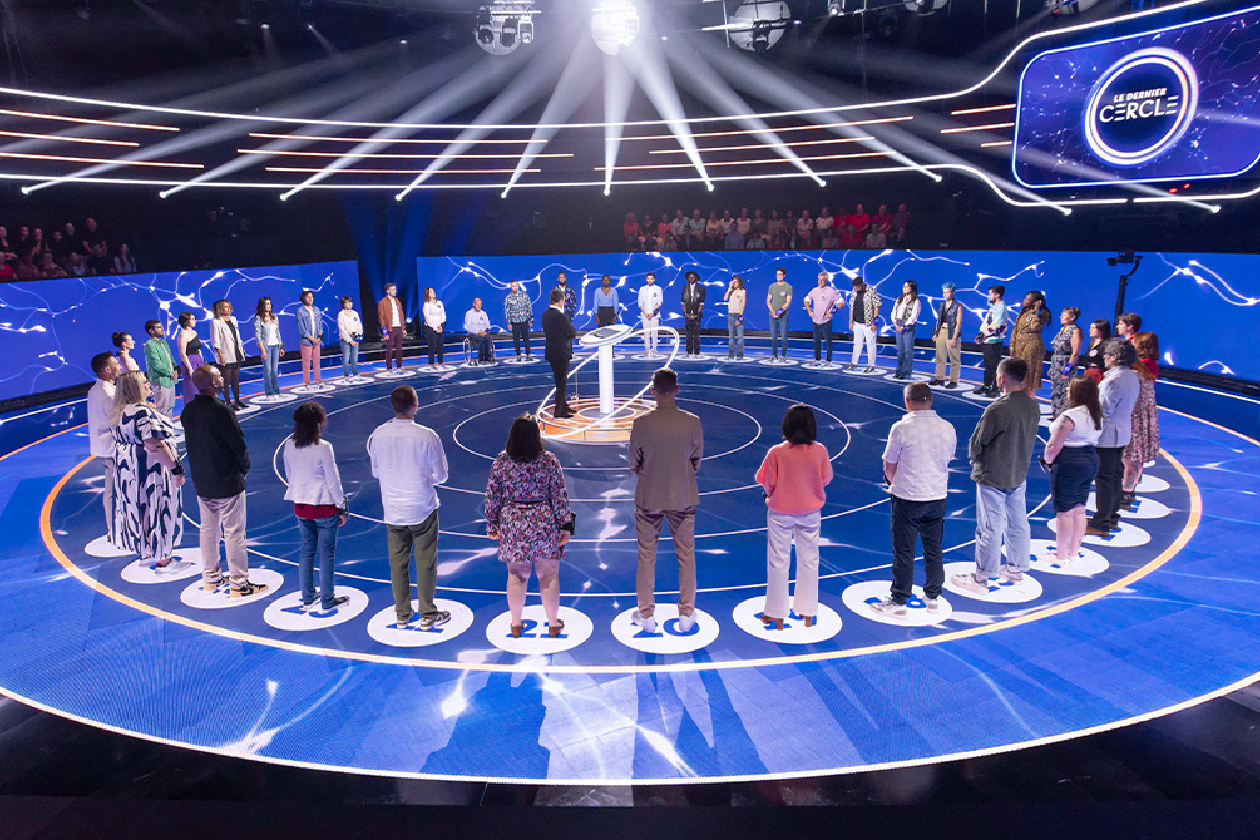
TF1’s EVP of content development, Julien Degroote, said his main focus is on finding formats that have the potential to turn into long-running franchises. He believes two of the primetime formats launched on TF1 last year have that potential: Satisfaction’s Le Dernier Cercle (The Final Circle, pictured), “a quiz show with a strong visual identity,” and the adaptation of the comedy gameshow Nation’s Dumbest. “That was a risky bet for us, but it turned out to be our best format launch in five years,” he said.
Degroote is looking for game shows with iconic sets, serialized “dilemma” shows shot on location, “shiny floor always!”, and reality series incorporating gamification, mostly for his smaller channels’ daily strands. In the latter area, the broadcaster found success with French show Les Tricheurs (Dirty Players) on TFX, which he described as a channel acting as “our playground for bold, fun entertainment formats.”
Overall, game shows are having a moment right now in France. M6, which previously focused less on the genre, successfully introduced reboots of Wheel of Fortune and The Weakest Link into its schedule. But according to Pierre-Guillaume Ledan, deputy managing director of unscripted programming for Groupe M6, the flagship channel is especially looking for formats with high streaming potential to help grow its digital platform M6+. Its biggest unscripted hits include The Traitors, Married at First Sight, Pékin Express and Temptation Island.
A format’s digital potential has become a key priority for all the channel groups. France Télévisions has embarked on a “streaming-first” strategy and just launched the original format Les Chaises Musicales Infernales (That’s My Chair) on YouTube and france.tv prior to its TV broadcast. “Talent shows, game shows, the next big event… we look at everything,” said Alexandra Redde, head of entertainment for FTV.
Meanwhile, the RMC channels are looking to forge partnerships with YouTube creators, as they did with Joyca, coproducing and airing a new episode of his YouTube series which explores places around the world rated by travellers with just one star. “Our channels have a documentary and factual DNA,” noted Charles Bariller, deputy head of content. However, they also want to entertain, and he expressed satisfaction with the recent reboots of several entertainment brands, such as Sewing Bee on lifestyle channel RMC Life.
PUSH will return in 2027 with dates to be announced soon, according to organizers who are currently exploring ways to expand the event.
(Photo: WBITVP/Satisfaction Group)
